Sustainability in Academia (Article 11, April 2026)
 Santhosh Jayaram
Recently, I was preparing for my exam on Ethics in Management Research and was reading classical ethics theories like Consequentialism and Deontology. While reading I started relating these theories to CSR, especially corporate foundations and to Philanthropy. Somehow, even after the exam, I was ruminating over these ideas, and decided to take a deep dive, resulting in this analytical piece.
Let’s pick up consequentialism first, relating it to CSR. It asks a relatively straightforward question: Does CSR and philanthropy lead to ‘good’ outcomes? In most cases, the answer appears self-evident – yes, it does. It directs resources toward social causes, addresses gaps, and creates visible impact on the ground.
But Deontology pushes us toward a far more uncomfortable question: What makes CSR and philanthropy “good” in the first place and who gets to define, justify, and legitimize that idea of good?
Because “doing good” is not just about outcomes. Under the deontological lens, it is about duty, intent, and moral justification, independent of outcomes. And the moment we ask who decides what counts as good, the discussion shifts to a question of power.
This is the 11th article in my series Sustainability in Academia, where I attempt to bring academic research into practitioner conversations in sustainability, CSR, and impact. For this piece, I draw on a recent academic contribution – “Philanthropic Foundations and the Exercise of Power: An Integrative Literature Review of the Many Faces of Power” by Lauren Dula, Laurie E. Paarlberg, and Imoleayo Adeyeri, published in Nonprofit and Voluntary Sector Quarterly (2025). [1]
The paper reviews 219 peer-reviewed studies to understand how philanthropic foundations operate as sites of power and not just as agents of generosity .Philanthropy is often positioned as an unquestioned moral good. But this body of research suggests that it is far from neutral. Foundations do not merely fund solutions, they shape what problems are seen, how they are framed, and which responses are considered legitimate. More importantly, they influence the very idea of what constitutes the “public good.” In doing so, philanthropy moves beyond generosity into the realm of moral authority.
To unpack how this moral authority operates in practice, the authors draw on Fleming and Spicer’s framework of the “faces of power,” identifying four distinct but interrelated ways in which philanthropic foundations exercise influence: coercion, manipulation, domination, and subjectification . These are not isolated or sequential forms of power; they often overlap and reinforce one another, ranging from visible, direct influence to more subtle, systemic shaping of ideas, norms, and identities.
Although the article limits itself to philanthropy, I feel that the arguments are very well suited to the CSR and corporate foundation ecosystem that is prevailing in India.
Coercion: When Duty Is Directed
One of the most visible expressions of authority is coercion.
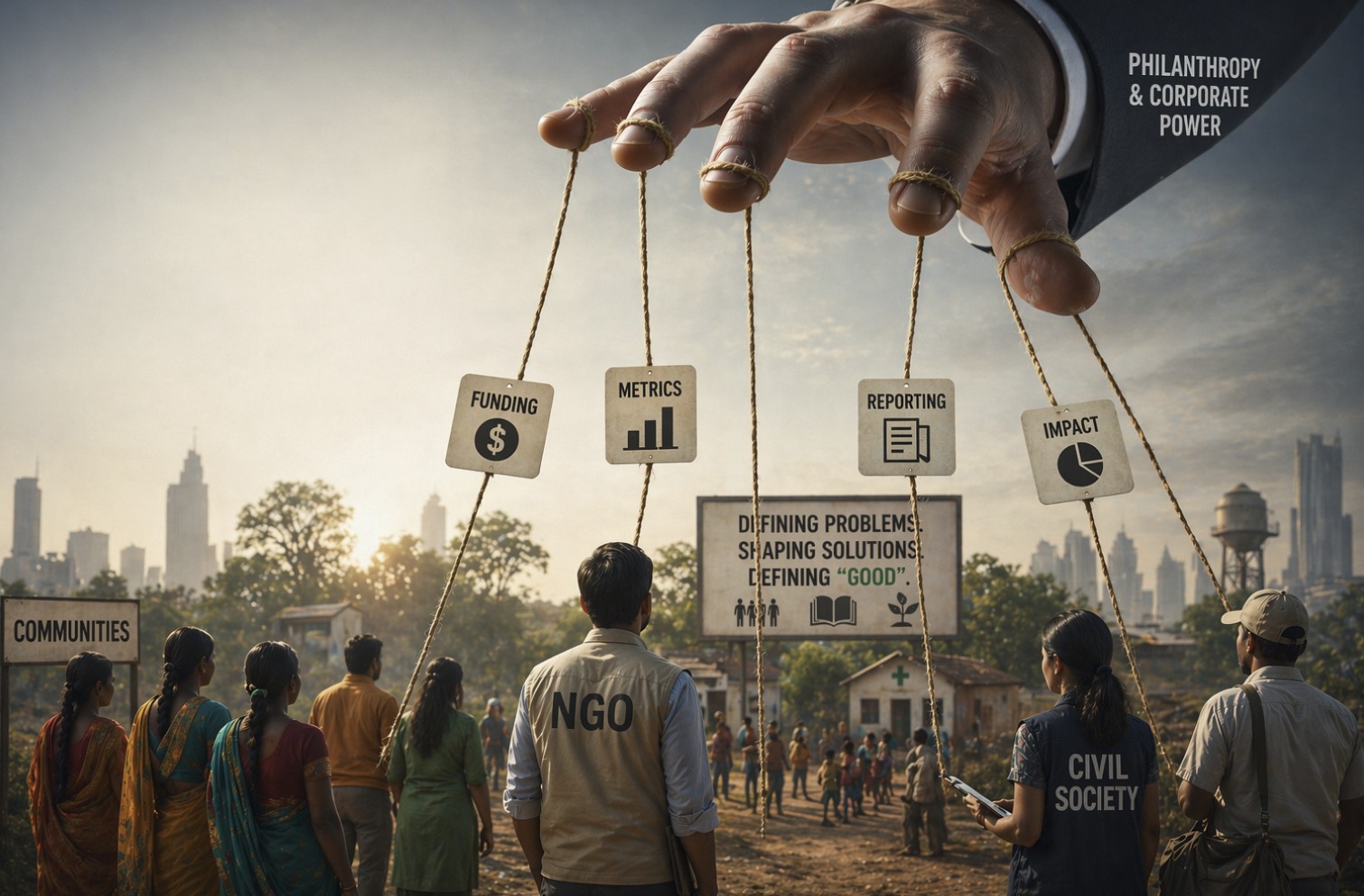
Philanthropy often operates through what can be described as strings-attached-philanthropy, where funding is contingent upon compliance with predefined frameworks, metrics, and structures. Organizations must align themselves with donor expectations to access resources. Isn’t this true in the CSR and corporate foundation ecosystem in India?
At one level, this may appear efficient. But at a deeper level, it raises a Deontological question:
- If duty is externally defined, is it still moral duty?
- Or has it become compliance?
Civil Society Organizations may pursue outcomes that are beneficial, but their intent and autonomy are shaped by the conditions of funding.
Manipulation: Determining What Counts as Duty
If coercion directs action, manipulation defines the boundaries of thought. CSR and Philanthropic actors often determine what issues merit society’s attention, which problems are prioritized, and which solutions are legitimized .
This is not overt control, it can be seen as agenda-setting. Entire fields of work can emerge or disappear depending on:
- What gets funded
- What gets researched
- What gets measured
In this sense, CSR and philanthropy does not just support action, it defines duty itself. And increasingly, foundations act as policy entrepreneurs, shaping public discourse and influencing policy directions through knowledge networks, think tanks, and advocacy ecosystems.
Domination: The Ideology of “Good”
Beyond action and agenda lies a deeper layer, domination. Domination works through ideology. It shapes what people believe is right, natural, and desirable. Over time, these beliefs become so embedded that they are no longer questioned.
Research shows how philanthropy has played a role in spreading neo-liberal, pro-market values, framing market-based approaches as the default solutions to social problems .
This has implications for how “good” itself is understood:
- Efficiency becomes a moral virtue
- Scale becomes a marker of legitimacy
- Measurability becomes a proxy for impact
Alternative ways of knowing – community wisdom, lived experience, local context – are often sidelined.
Subjectification: Becoming the Duty We Did Not Choose
The most subtle form of power is subjectification. At this stage, civil society organizations internalize dominant norms. They begin to act in alignment with philanthropic frameworks, not because they are compelled, but because they believe it is the right thing to do. For many working in the social space in India, you can sense this happening in India.
They become subjects of power. This is where power becomes invisible.
- NGOs reshape their missions to fit donor language
- Communities adopt externally defined aspirations
- Practitioners align their identities with funding logics
Duty is no longer imposed. It is internalized. From a Deontological perspective, this is perhaps a critical concern – Can intent be considered authentic if it is shaped by systemic influence?
The Democratic Question of Moral Authority
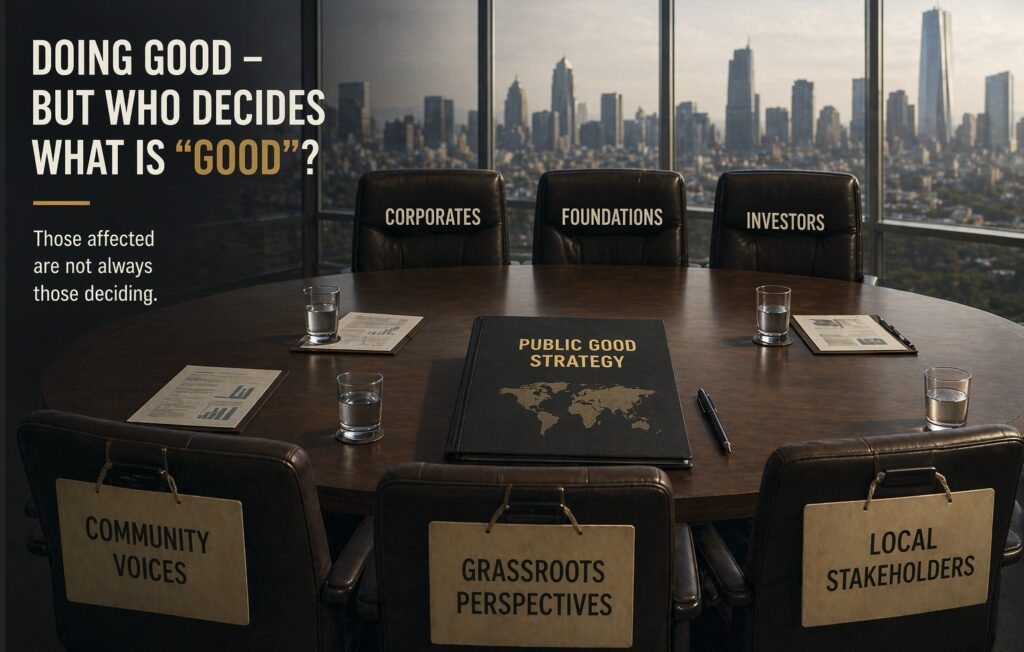
All of this leads us back to a fundamental tension – Who decides what is “good”?
In democratic systems, moral direction ideally emerges from collective processes. But CSR and philanthropy operates outside these structures.
Foundations are unelected, yet capable of influencing public policy, knowledge systems, and social priorities
For practitioners, researchers, and institutions working in social impact, development, and public systems, this question of “who decides good?” is not abstract.
Across sectors, we operate within environments where:
- Resources shape priorities
- Metrics shape meaning
- Funders shape direction
What gets attention is rarely accidental. It is structured by funding flows, institutional incentives, and dominant narratives. In such a context, “doing good” can easily become:
- Agenda-driven rather than need-driven
- Compliance-oriented rather than purpose-driven
- Standardized rather than contextual
The risk is not that good work is not happening. The risk is that the definition of good becomes narrow, uniform, and externally determined.
If we are to engage meaningfully with the idea of “doing good,” we must create space for:
- Multiple definitions of what “good” means
- Voices that are usually excluded from decision-making
- Approaches that are grounded in context rather than templates
This is not an argument against CSR or philanthropy. It is an argument for reflection.
A more ethically grounded approach for CSR and Philanthropy would:
- Recognize power, rather than obscure it
- Shift from control to co-creation
- Enable communities to define their own priorities
It would ask not just – “What impact are we creating?” But also – “Whose definition of impact are we using?”
CSR and Philanthropy often begins with the intention of doing good. But intention alone is not enough. Because in a world shaped by unequal power, the ability to define “good” is itself a form of power. So perhaps the real ethical question is not whether CSR and philanthropy does good.
It is this:
When we say we are doing good, are we responding to a collectively defined moral direction or advancing a definition of good shaped by those who hold disproportionate power?
It is not just about better outcomes. It is about ensuring that the authority to define those outcomes remains shared, contested, and just.
[1] Dula, L., Paarlberg, L. E., & Adeyeri, I. (2025). Philanthropic foundations and the exercise of power: An integrative literature review of the many faces of power. Nonprofit and Voluntary Sector Quarterly. https://doi.org/10.1177/08997640251332893
Article 1: Higher the ESG Score, Higher the Risk of Green Washing
Article 2: Do We Really Care for Climate Change-Related Targets?

Article 3: The Hidden Cost of SDG Progress: Who’s Paying the Price?

Article 4: How susceptible are you to being Greenwashed?

Article 5: The Great Indian Political CSR

Article 6: What Does “G” Say About “E” of ESG?

Article 7: The Planet is Heating, So Is Literature: A Cli-Fi Conversation

Article 8: Good Intentions, Fragile Support: Why Climate Action Needs Better Policy Design

Article 9: The Truth We Hoped Wasn’t Empirical: Sustainability Bends Under Earnings Pressure

Article 10: What Gets Managed Gets Reported

Cutting through academic jargon, this monthly series distills key findings from sustainability research into actionable insights for professionals and decision-makers.