Often labelled as environmentally-unfriendly, borewells can be green too- depending on the mindset and technology employed for recharge- argues this innovator.
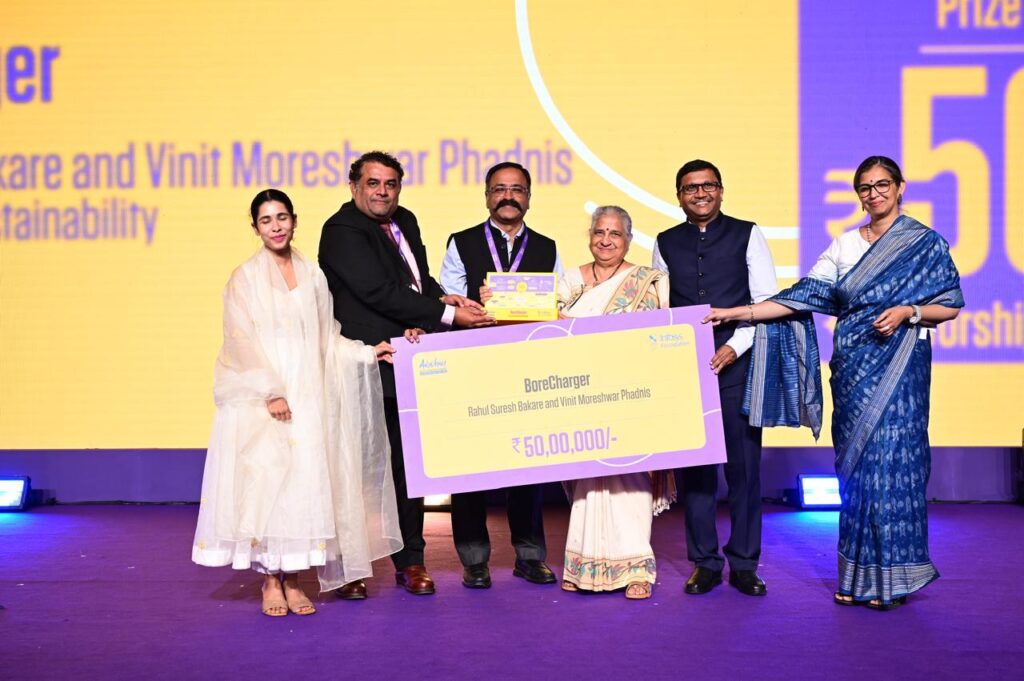
Rahul Bakare, Founder & CEO, Urdhvam Environmental Technologies Pvt. Ltd. won a lot of spotlight at the Infosys Foundation’s Aarohan Social Innovation Awards (that recognises and rewards teams that develop breakthrough solutions for social good) for Borecharger, claimed to be the world’s first robotic artificial borewell-recharge technique. This innovation promises to inject between 4 to 80 lakh litres of rainwater into existing borewells annually- thus helping in improving irrigation, enhancing farm productivity and farmer income, while also increasing both the quality and quantity of drinking water, ultimately making habitations more sustainable. Does this work? And how? We drill further in this interview with Mr. Bakare.
What’s really path-breaking with this technology solution? What big differences do robots bring in this realm?
Firstly- In-bore, targeted perforation (patented). BoreCharger perforates existing casing from inside at hydro-geologically appropriate depths using a robotic tool — a capability most competitors (surface recharge, MAR ponds, recharge pits) do not offer. This lets you revive already-drilled wells without land take or redrilling. Then there is the Angiography → Angioplasty workflow- Pre-treatment downhole video (angiography) to map lithology and confirm target zones, then precise perforation (angioplasty). This reduces failed interventions and builds trust. It also combines Robotics with automation- Offering safer, repeatable, and auditable operations; lowers risk of human error compared to ad-hoc mechanical hacks used by local contractors. This realm of Groundwater does not have any robotic technologies. Oil rigs and Drilling Boreholes for Oil have some capabilities but nothing similar to BoreCharger and that too not for Groundwater
How does this crack the green-borewell paradox? Is it like giving better teeth to the beast – given the general perception that borewells have (negative connotation in terms of environmental-impact on groundwater)?
Technology is never bad, its usage by humans is. A knife is not bad but its usage for killing someone is. Borewell technology has its advantages of affordability, less space required, decentralised usage such as irrigation, drinking, etc. We, as humans, are using them for abstraction purposes only and have neglected recharge required to sustain the borewell. Hence if a borewell is recharged with more or equal quantum of rainwater than the quantum of abstracted groundwater, then the borewell would last longer. The negative connotation is given by not-much-aware environmentalists who are only criticising the borewell rather than solving the problem of lack of recharge. BoreCharger exactly solves this issue of lack of borewell recharge and converts a non-performing abstraction only borewell into a self-recharging and sustainable source.
The negative connotation is given by not-much-aware environmentalists who are only criticising the borewell rather than solving the problem of lack of recharge: Rahul Bakare
Does this solution face any ecosystem compatibility, on-ground adoption, and infrastructure issues?
When it comes to ecosystem compatibility challenges- we can consider Casing Material & Condition: Very thick steel casing, damaged PVC, or eccentric installation can complicate robotic perforation. As to on-ground adoption challenges, there is a significant awareness & trust Gap. Farmers and households often believe “new drilling = new water”, so shifting them toward recharge-first thinking takes sustained awareness efforts. There is also a ‘Perceived Cost vs. Immediate Benefit’. Some users expect instant yield improvement; geological recharge takes time, making short-term expectations difficult to manage. We also observe lack of documentation. Many borewells lack depth logs, casing depth records, or geology reports, increasing diagnostic effort. Plus, the water availability for recharge and pump issues are infrastructure-related problems. Areas with extremely low rainfall or no RWH infrastructure may not generate enough water for effective injection. Inefficient or oversized pumps may continue over-extracting despite recharge, limiting long-term benefit. Also, urban or industrial sites may have difficult access, encroachments, or safety restrictions around borewell heads.
Any examples or data on the outcomes seen on productivity, water quality, and rainwater retention?
BoreCharger increases recharge of borewells 4 to 20 times that of natural recharge. Depending upon the hydrogeology of the location BoreCharger induces artificial injection recharge of between 2 Lac to 80 Lac Litres of rainwater in the borewell/year. There is also an increase in duration of water supply by Additional 1 to 6 more months. Plus, improved irrigation & drinking water quantity provided by borewells intraday, inter season, improved quality of borewell water, improvement in TDS from 800 to 450-500 within one year and reduced pumping energy costs and competition for water. We also see reduced energy consumption by 30 per cent due to improved borewell water levels, improved farm output production by average 30-60 per cent and farm income by additional 30-150 per cent, along with reduced cost of tanker water supply by 30-60 per cent.
Does it also affect soil-health, aquifer depth, salination reduction, groundwater mapping etc.
Yes. Artificial Injection of fresh water from topmost aquifer, results in dilution of dissolved salts, a.k.a. salinity of borewell water supply and hence salination of soils is reduced due to BoreCharger induced recharge activity. BoreCharger does not affect aquifer depth, groundwater mapping. There is no connection between aquifer depth and groundwater mapping and BoreCharger induced recharge and hence are not at all negatively affected.
Any chance this technology can find use-cases in borewell rescue areas too?
No. This technology would not have any use-case in borewell rescue areas. Example : if a child is stuck in borewell BoreCharger technology cannot help rescue the child.
What are your future plans with this solution- technologically and geographically?
Our future technological plans include Next-gen robotic perforation for higher precision, quality assurance and scalability, Integration with Jalstr Groundwater Sensor for real-time recharge performance, Digital twin of each borewell for recharge simulation and Portable, faster field units for mass deployment. Our geographic expansion strategy entails scale across drought-prone regions: Marathwada, Bundelkhand, Rayalaseema, Urban recharge programs: Bengaluru, Pune, Chennai, Hyderabad, global opportunities in Africa, Middle East & South Asia as well as partnerships with municipalities, CSR missions, NGOs & multilateral agencies.
By Pratima H