Sustainability in Academia (Article 10, March 2026)
 Santhosh Jayaram
“What gets measured gets managed,” is a quote attributed to author and educator Peter Drucker. It has become a sort of management mantra, quoted liberally in business and in sustainability circles, especially when it comes to reporting.
However, when we examine sustainability disclosures today, something feels amiss. It seems like a paraphrase to the original quote, this time though: “What gets managed gets reported.”
This is the 10th in the Sustainability in Academia series, where I attempt to translate academic research into reflections for sustainability practitioners. This time, I draw on a recent study examining materiality and stakeholder alignment in sustainability reporting (Cho et al., 2026). The paper explores how companies define what is “material” in sustainability disclosures. It compares corporate sustainability disclosures with stakeholder priorities.
The conclusion is simple and uncomfortable. There is a persistent misalignment between what companies report and what stakeholders actually care about.
The study uses Nestlé as a case.
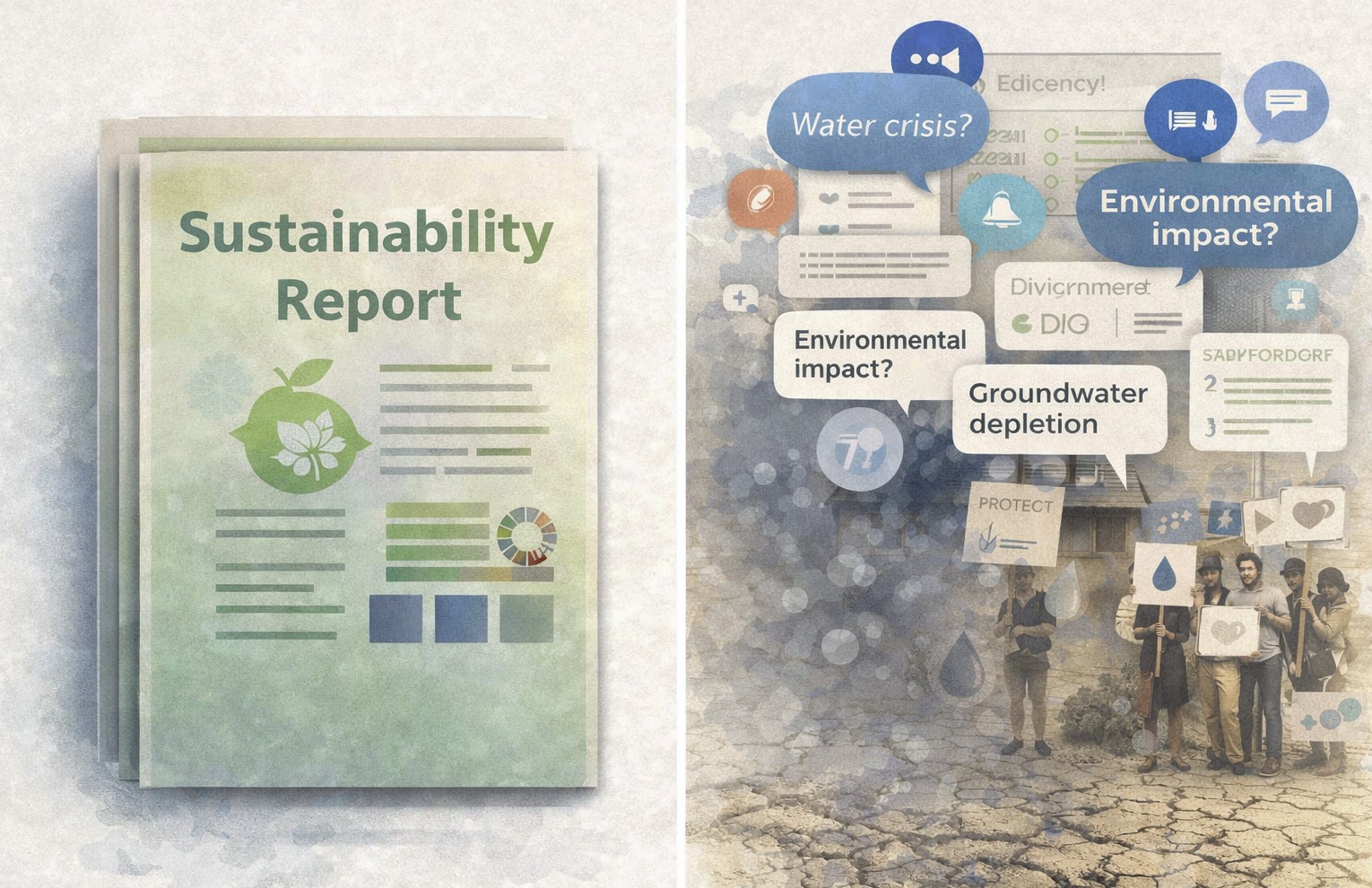
On paper, the company presents a well-structured materiality matrix. It reflects alignment with sustainability priorities and the SDGs. It looks complete. But when the researchers compare this with stakeholder conversations, drawn from thousands of social media interactions, a different reality appears.
Stakeholders place significantly higher importance on issues like water and environmental impact. These do not receive the same prominence in the company’s disclosures. Interestingly, while the company highlighted areas such as nutrition and production efficiency, stakeholders were far more vocal about water-related concerns, especially in the context of environmental stress and resource usage. What the company chose to emphasise, and what stakeholders cared about, was not in alignment.
If our ‘measure equals manage’ hypothesis held fully in the sustainability context, measurement would be driven by what matters. Stakeholder expectations would shape KPIs, and KPIs would in turn shape management response. Yet, going through the sustainability reports, the linkage between stakeholder expectations, context, and KPI identification is often weak, if not broken.
This is not entirely accidental. It has been curated through the global standards like GRI. While the general concept of reporting on relevant or “significant” information existed in earlier versions of GRI, it was in the GRI G3 version in 2006 that the formal Materiality Principle was introduced. I was one of the committee members developing the G3 guideline. Below is a snippet of what happened to the Materiality Principle between GRI G3 and G3.1.
Earlier versions of GRI approached materiality through context (the significance of economic, environmental, and social impacts – X axis) and through stakeholder expectation (Influence on stakeholder assessments and decisions – Y Axis)
This shifted in G3.1 (to all later versions). As seen in the evolution of the materiality matrix , the emphasis shifted toward significance to the organization (X Axis) and significance to stakeholder (Y Axis).
It seems subtle, but the change is substantial. The difference becomes clearer when we consider the level of informational asymmetry between organisations and stakeholders.
Under GRI G3, if an issue like water had a significant impact and influenced stakeholder decisions, it was material. Under G3.1 and later versions, even if stakeholders consider it important, the organisation can still choose to position it lower.
The Nestlé case, as reflected in this study, reflects this clearly. It is prepared to communicate what is managed well. And chooses to ignore what isn’t.
The study also delves on the influence of technology in relation to stakeholders’ expectations. Today, there are ways to understand in real-time, context-driven understanding of stakeholder expectations. The idea was simple. Instead of relying only on structured stakeholder engagement, why not continuously scan the digital ecosystem – social media, web platforms, public discourse – to understand how stakeholders are actually perceiving the organisation?
Towards the end of my tenure at KPMG India, I was exploring something similar. Speaking to some of the tech Partners recently, I understand that Agentic AI can do a far better job than I had envisaged 6 years back. We can look at key aspects of stakeholders’ interest, their perception, sentiment, the level of engagement and reach. We can track changes over time in almost a live environment.
What this enables is powerful.
First, it helps identify material topics as they emerge, not just as they are reported.
Second, it provides a segmented view of stakeholders across regions, age groups, and contexts.
Third, and perhaps most important, it acts as an early warning system. Before any sustainability issue becomes a crisis, it appears as a signal, and the trend gives us a sense of the risk.
The challenge is not with measurement itself. It is with what informs measurement.
Technology today makes it easier than ever to understand stakeholders in real time.
But unless we consciously integrate that into how we define materiality, we will continue to report what we manage, not manage what truly matters for sustainability.
Reference:
Cho, C. H., Dobija, D., Krasodomska, J., She, C., & Zarzycka, E. (2026). Materiality assessment and interconnectedness of sustainable development goals: Uncovering misalignments between corporate and stakeholder priorities. Sustainability Accounting, Management and Policy Journal.
Article 1: Higher the ESG Score, Higher the Risk of Green Washing
Article 2: Do We Really Care for Climate Change-Related Targets?

Article 3: The Hidden Cost of SDG Progress: Who’s Paying the Price?

Article 4: How susceptible are you to being Greenwashed?

Article 5: The Great Indian Political CSR

Article 6: What Does “G” Say About “E” of ESG?

Article 7: The Planet is Heating, So Is Literature: A Cli-Fi Conversation

Article 8: Good Intentions, Fragile Support: Why Climate Action Needs Better Policy Design

Article 9: The Truth We Hoped Wasn’t Empirical: Sustainability Bends Under Earnings Pressure

Cutting through academic jargon, this monthly series distills key findings from sustainability research into actionable insights for professionals and decision-makers.