
Editor’s note: these facts were compiled in January 2016, shortly after the first 20 smart cities were announced. The Smart Cities Mission’s timeline and funding have changed since, and we will update this page.
India’s Smart Cities Mission set out to transform how the country’s cities are planned, run and lived in. Here is what the mission promised at its launch, why it was needed, and how it fits into India’s long history of city-building.
100 smart cities
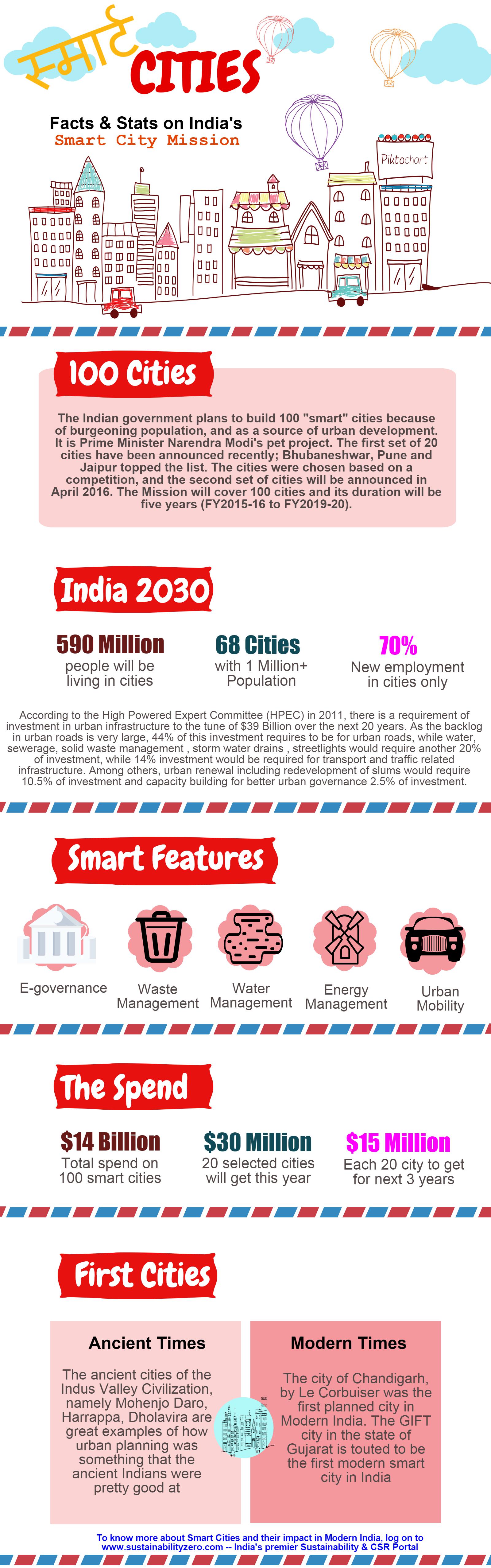
The government plans to develop 100 smart cities to cope with a fast-growing urban population and to drive urban development. The mission is a flagship project of Prime Minister Narendra Modi. The first 20 cities were announced in January 2016, with Bhubaneswar, Pune and Jaipur at the top of the list. Cities were chosen through a competition, and the next round was due in April 2016. The mission covers 100 cities over five years, from 2015-16 to 2019-20.
India in 2030
The pressure on India’s cities is only going to grow. By 2030:
- 590 million people will be living in cities.
- 68 cities will have a population of more than 1 million.
- 70 per cent of new jobs will be created in cities.
The High Powered Expert Committee (HPEC) on urban infrastructure estimated in 2011 that India needs to invest about ₹39.2 lakh crore in urban infrastructure over 20 years. Because the backlog in urban roads is so large, 44 per cent of that investment is needed for roads. Water supply, sewerage, solid waste management, storm water drains and streetlights together need another 20 per cent, and transport and traffic infrastructure 14 per cent. Urban renewal, including the redevelopment of slums, would need 10.5 per cent, and capacity building for better urban governance 2.5 per cent.
What makes a city smart
The mission focuses on five areas:
- E-governance: putting citizen services online.
- Waste management: collecting, segregating and processing solid waste.
- Water management: reliable supply, metering and cutting losses.
- Energy management: efficient lighting, smart grids and renewable energy.
- Urban mobility: public transport, walkability and traffic management.
The spend
- About $14 billion was set aside for the 100 smart cities.
- About $30 million (₹200 crore) goes to each of the first 20 cities in the first year.
- About $15 million (₹100 crore) goes to each of those cities every year for the next three years.
India’s first cities
Ancient times: The cities of the Indus Valley Civilisation, including Mohenjo-daro, Harappa and Dholavira, show that urban planning is nothing new for India. Their grid layouts, drainage systems and water management were remarkably advanced.
Modern times: Chandigarh, designed by Le Corbusier, was the first planned city of independent India. GIFT City in Gujarat has been described as India’s first modern smart city.