Nothing like getting hotel rooms with a green view, inside and out- that too near the runway. Let’s take a peek into some efforts in that direction
Over the next three decades, global passenger numbers could touch 17.7 billion by 2043 and 22.3 billion by 2053 (this is nearly 2.4 times the projected volume for 2024) as surmised by Airports Council International (ACI) forecasts. With such a titanic footprint, airports also see a long runway lined up on the environmental implications of every drop of fuel that is guzzled and every seat that flies. While IATA and its members have the goal to achieve net zero CO2 emissions by 2050, the decarbonisation and all-scope emissions facets of an airport are going to become brighter than before on this industry’s radar. Consider what a 2026 Airport Tracker report (ODI Global/ T&E) found – just 100 airports worldwide account for two-thirds of global aviation’s CO2 emissions, marking airports among the most concentrated sources of climate pollution anywhere.

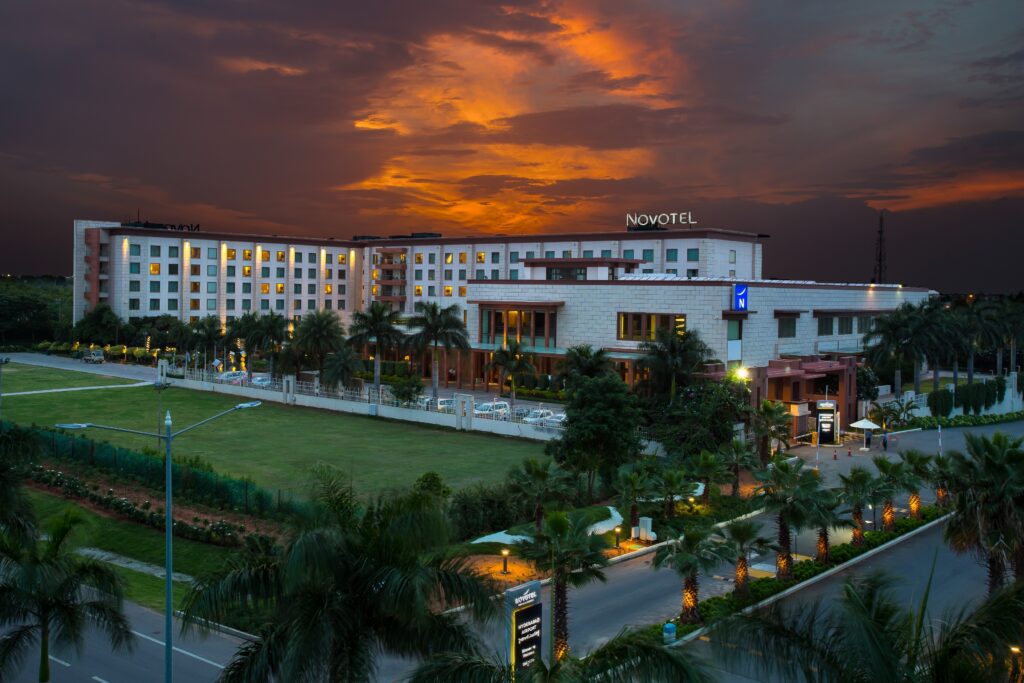
Incidentally, or not so, that makes adjacent ecosystems like hotels all the more relevant to the environmental side of aviation. It’s interesting to see here what is happening at Novotel Hyderabad Airport, the city’s only airport hotel. This hotel, avowedly, is not treating its location as a liability, but has built its operations into a circular economy around water, food, and energy, going well beyond guest-facing plastic reduction. Its leaders proclaim that ‘compliance’ can be just the starting point for Sustainability, which has massive and wide-spanning impacts on operating costs, customer perception and certifications. Sukhbir Singh, General Manager, Novotel Hyderabad Airport escorts us through some corridors of circular economy principles being applied in hospitality; and how plastic usage, water circularity, and energy footprint affect a hotel’s accounting as well as accountability.
Proximity to airport—is that a challenge or a new opportunity for sustainability efforts?
Being an airport hotel presents both challenges and opportunities. As the only premium hotel within the airport community, the hotel enjoys exceptional visibility among frequent business and leisure travellers visiting the city. This strategic location provides an excellent platform to showcase the hotel’s sustainability initiatives to a diverse and high-volume guest base.
To support sustainable mobility, the hotel offers complimentary scheduled shuttle services to and from the airport, provides electric vehicle (EV) transfer options for guests, and has an on-site EV charging station.
When it comes to materials and equipment—do you look at local procurement options, repairability and recyclability?
The hotel’s close proximity to the airport significantly reduces guest travel distances, contributing to lower transportation-related fuel consumption and helping to minimise the hotel’s Scope 1 greenhouse gas emissions.
We minimise our operational footprint through efficient energy use, responsible waste management and resource conservation. We actively prioritise local sourcing wherever feasible to reduce transportation emissions and support regional businesses. During procurement, we increasingly evaluate products based on durability, repairability, lifecycle performance and recyclability rather than simply upfront cost.
Is sustainability a tough goal for any hotel’s top strategic radar? Is it worth the time and effort?

Sustainability is no longer an optional initiative—it is a business imperative. In hospitality, every decision impacts energy, water, emissions, waste generation and the guest experience. The challenge is integrating sustainability into daily operations without compromising comfort or service.
The effort is certainly worthwhile because it delivers long-term environmental benefits while also improving operational efficiency, reducing costs and strengthening brand reputation. Increasingly, guests and corporate clients prefer hotels that demonstrate responsible practices.
Is it more than compliance? Any business impacts at all? Was it your approach for the last 17 years or something that has emerged on the way?
Sustainability goes far beyond regulatory compliance. Compliance is the starting point, but true sustainability is about building a resilient business.
Over the years, guest expectations have evolved significantly. What began as responsible resource management has become a strategic pillar influencing procurement, design, operations and customer engagement. We’ve seen tangible business benefits including lower operating costs, stronger employee engagement, increased preference from environmentally conscious travellers and recognition through certifications like Green Key.
Anything that you can share about the Green Key certification—bagged again this year?
We are proud to have successfully renewed our Green Key certification for the third consecutive year, reinforcing our commitment to internationally recognised environmental standards.
Green Key is not simply a certification; it requires continuous improvement across energy management, water conservation, waste reduction, sustainable procurement, employee training and guest awareness. For us, the certification validates that sustainability is embedded in our daily operations rather than being a one-time achievement.
Does circularity align well with customer experience standards? Any conflicts anywhere?
Circularity complements guest experience when implemented thoughtfully.
Today’s guests increasingly appreciate initiatives like refillable bathroom amenities, glass bottled water, reduced single-use plastics and responsible linen reuse programmes. The key is making sustainable choices convenient rather than restrictive.
Do guests cooperate enough or show understanding and appreciation here?
Most guests respond positively when they understand the purpose behind these initiatives. Clear communication helps transform sustainability from an operational process into a shared responsibility.
Tell us about some highlights of sustainability initiatives at NHA. Do you also cover plastic usage areas here?
Yes. Plastic is solved at scale. NHA runs an in-house water bottling plant using reusable glass bottles, eliminating an estimated 30,000 single-use plastic bottles a month. We also work on using ‘Waste as a Resource’. Food waste is converted into organic manure that feeds an on-site herb garden – a closed loop from plate to soil – supported by local sourcing that also cuts down transportation footprint.
Anything on water and energy areas?
Water circularity is a key initiative we have taken. STP-treated water is reused for landscaping, alongside rainwater harvesting and water-efficient fixtures – measures that carry extra weight in a year when erratic rainfall is a live national concern. On the fronts of Energy and mobility- 6,000 LED bulbs, solar water heaters, renewable energy use, an EV charging station and EV guest transport, and non-CFC cooling systems round out the picture. At NHA, the underlying idea is that every resource – water, food waste, energy – is treated as something to keep in use, not discard, and none of it comes at the cost of the guest experience. Operating in the shadow of one of the industry’s most carbon-intensive assets, NHA is proof that hospitality tied to aviation does not have to inherit its environmental footprint.
Solving plastic at scale can be quite challenging. Tell us how you do that consistently, especially with multiple stakeholders and supply chain emissions.
Plastic reduction requires collaboration across the entire value chain. At our hotel, we’ve eliminated several single-use plastic items by introducing an in-house water bottling plant with reusable glass bottles and transitioning to refillable dry and wet bathroom amenities, significantly reducing plastic waste. We also work closely with suppliers to minimise packaging, encourage reusable alternatives, and continuously educate employees on waste segregation and responsible consumption. Consistency comes from embedding sustainability into our standard operating procedures, making it an integral part of our daily operations rather than a standalone initiative.
What makes circularity significant for climate-change responsibility? How is that achieved for resources like water? Is it a cost burden?
Circularity helps keep valuable resources in use for as long as possible while reducing waste and emissions.
Water conservation is a great example. Through rainwater harvesting, efficient fixtures, aerators and continuous monitoring, we’ve substantially reduced freshwater consumption while maintaining guest comfort. The treated water from the Sewage Treatment Plant (STP) is fully reused for landscape irrigation, including the hotel’s expansive lawns, landscaped green areas, and herb garden, thus significantly reducing the demand for freshwater for horticultural purposes.
Many sustainability investments require initial capital, but they generate long-term savings through reduced utility costs, improved operational efficiency and lower environmental impact. We view sustainability as an investment rather than an expense.