Sustainability in Academia (Article 9, February 2026)
 Santhosh Jayaram
With a title like that, one can’t help but dive straight in and start bluntly.
So here goes. If sustainability could be solved by creating one more committee, adding one more reporting template, and inserting the word “ESG” into a board charter, we would have made significant progress towards a sustainable world. But have we?
We have governance structures.
We have sustainability committees.
We have disclosure frameworks.
We have beautifully formatted reports printed on recycled paper.
And yet, emissions rise, disclosures are curated, and inconvenient data stays mysteriously out of reach.
So here is the uncomfortable question:
Can sustainability really survive inside the principal–agent pressures of modern corporations without strong leadership intent?
This is the ninth article in my Sustainability in Academia series, where I translate impactful academic research into ideas that matter for practitioners. For this edition, I have picked up the paper “The dynamics of selective environmental disclosure: Earnings pressure and environmental committee” by Cheng Chi and Yang Cheng, published in the Journal of Business Research [1], because it speaks directly to the uncomfortable question I raised above.
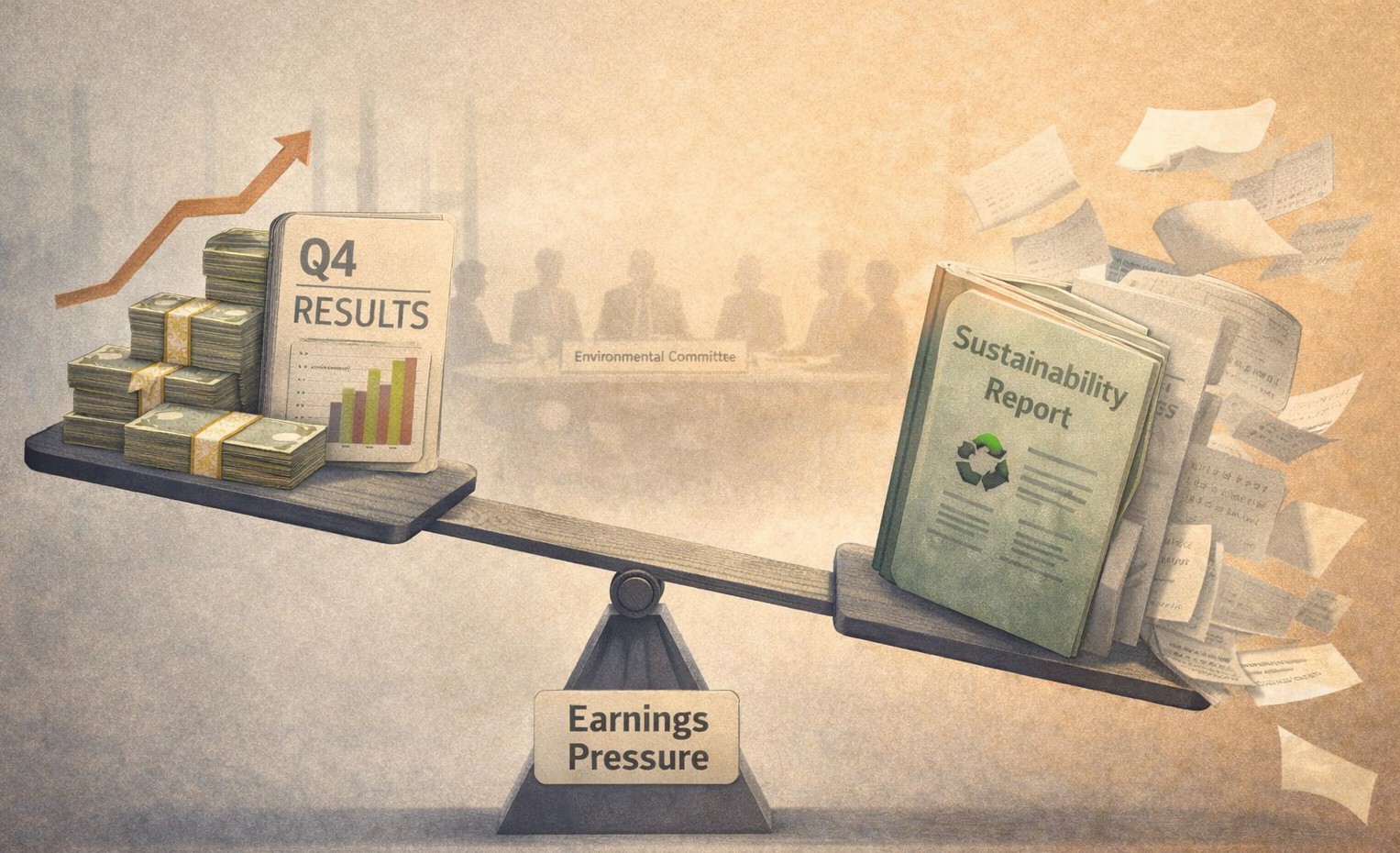
The authors investigate whether companies selectively disclose environmental information, especially when they are under earnings pressure.
Translation:
When managers are squeezed to deliver quarterly results, do they still tell the whole sustainability story?
Or do they tell the story that keeps investors calm?
They also examine whether having an environmental committee (a governance structure) moderates this behaviour.
In other words:
Does creating a committee fix the problem?
Or does pressure from shareholders quietly override sustainability transparency?
This is not a small perception survey. The study relies on a large panel dataset of publicly listed firms tracked over multiple years. Panel data matters because it allows researchers to observe firms across time, compare behaviour during periods of high and low earnings pressure, and control for firm-specific traits that might otherwise distort the picture. The authors employ regression analysis with multiple controls and interaction effects, along with robustness checks to ensure the results are not statistical accidents. The findings are not anecdotal.
And, the results say something that many business leaders likely knew, but perhaps hoped was not empirically provable. The study finds evidence of selective environmental disclosure under earnings pressure.
When firms face financial pressure, they are more likely to:
- Highlight favourable environmental metrics.
- Downplay or omit unfavourable information.
- Manage the narrative strategically.
In other words:
Sustainability reporting becomes — selective.
That is critical. other words: Sustainability reporting becomes — selective.
Now let’s add the governance twist.
The presence of an environmental committee does have some moderating effect — but it does not eliminate the behaviour entirely.
That is critical.
Committees help.
Structures matter.
But they are not immune to financial pressure.
The principal–agent problem quietly becomes visible. Shareholders (principals) expect financial returns. Managers (agents) are evaluated on performance metrics linked closely to those returns. Markets reward predictability and punish surprises. Sustainability investments, however, often require long-term thinking, upfront costs, and occasionally uncomfortable transparency. If environmental data complicates the earnings narrative, managers face a dilemma.
We like to believe that governance mechanisms can solve this tension. Create a sustainability committee. Assign oversight to the board. Include ESG metrics in performance reviews. It all sounds reassuring. And it is not meaningless. But governance structures operate within the incentive system; they do not transcend it. If incentives prioritise short-term financial performance, disclosure behaviour will reflect that priority.
There is a faint irony in our collective confidence in structure. We produce sustainability reports hundreds of pages long, full of metrics, charts, and assurance statements. We discuss materiality matrices and stakeholder engagement processes. Yet when earnings pressure rises, the narrative can still shift subtly. The inconvenient metric moves to page 173. The favourable statistic earns a headline.
For markets like India, where reporting frameworks are strengthening and governance norms are tightening, this finding carries an important message. Compliance and committees can raise the floor. They can formalise responsibility and create accountability channels. But they cannot fully neutralise the tension between short-term earnings expectations and long-term sustainability goals.
The deeper lesson from this research is not anti-governance. It is anti-illusion. Sustainability cannot be engineered purely through structures. It requires leadership intent strong enough to withstand market discomfort. It requires boards willing to defend transparent disclosure even when it complicates the financial story. It requires investors who value long-term resilience over short-term optics.
The principal–agent tension will not disappear.
Markets create pressure.
Pressure creates incentives.
Incentives shape behaviour.
But leadership intent can override incentives.
That is the real test of sustainability.
Because in the end, sustainability does not fail due to a lack of frameworks. It fails when conviction collapses under quarterly expectations. And no committee in the world can fix that.
Article 1: Higher the ESG Score, Higher the Risk of Green Washing
Article 2: Do We Really Care for Climate Change-Related Targets?

Article 3: The Hidden Cost of SDG Progress: Who’s Paying the Price?

Article 4: How susceptible are you to being Greenwashed?

Article 5: The Great Indian Political CSR

Article 6: What Does “G” Say About “E” of ESG?

Article 7: The Planet is Heating, So Is Literature: A Cli-Fi Conversation

Article 8: Good Intentions, Fragile Support: Why Climate Action Needs Better Policy Design

Cutting through academic jargon, this monthly series distills key findings from sustainability research into actionable insights for professionals and decision-makers.


Recent Comments