Sustainability in Academia (Article 7, November 2025)
 Santhosh Jayaram
(The term “Cli-Fi” was coined by journalist and blogger Daniel Bloom back in 2007 to describe the rising wave of climate-themed fiction.)
In the seventh of the series “Sustainability in Academia”, I am moving away from science and management to literature. This month, I pick up Andrew Milner’s essay What is Cli-Fi? for three reasons that arrived in a kind of cosmical alignment, as though the universe had decided to nudge me toward climate fiction and wanted me to write about literature instead of science and data. First, the recently concluded COP30, that annual ritual where world leaders gather to discuss climate change with the solemnity of a temple ceremony and the productivity of a group project in which only two people have actually read the brief, but all will argue. Second, just last week during a training session on climate risk, I found myself referencing Kim Stanley Robinson’s The Ministry for the Future. The book has become an involuntary tic in my professional vocabulary, popping up whenever someone mentions either “future scenarios” or “extreme heat stress.” Third, on the 29th of November, Bangalore will host the Green Literature Festival, and if a city is inviting us to celebrate the intersection of ecology and storytelling, why not lean into the moment? So here I am, venturing into ecocriticism, cli-fi, and the deliciously complex relationship between literature and climate action.
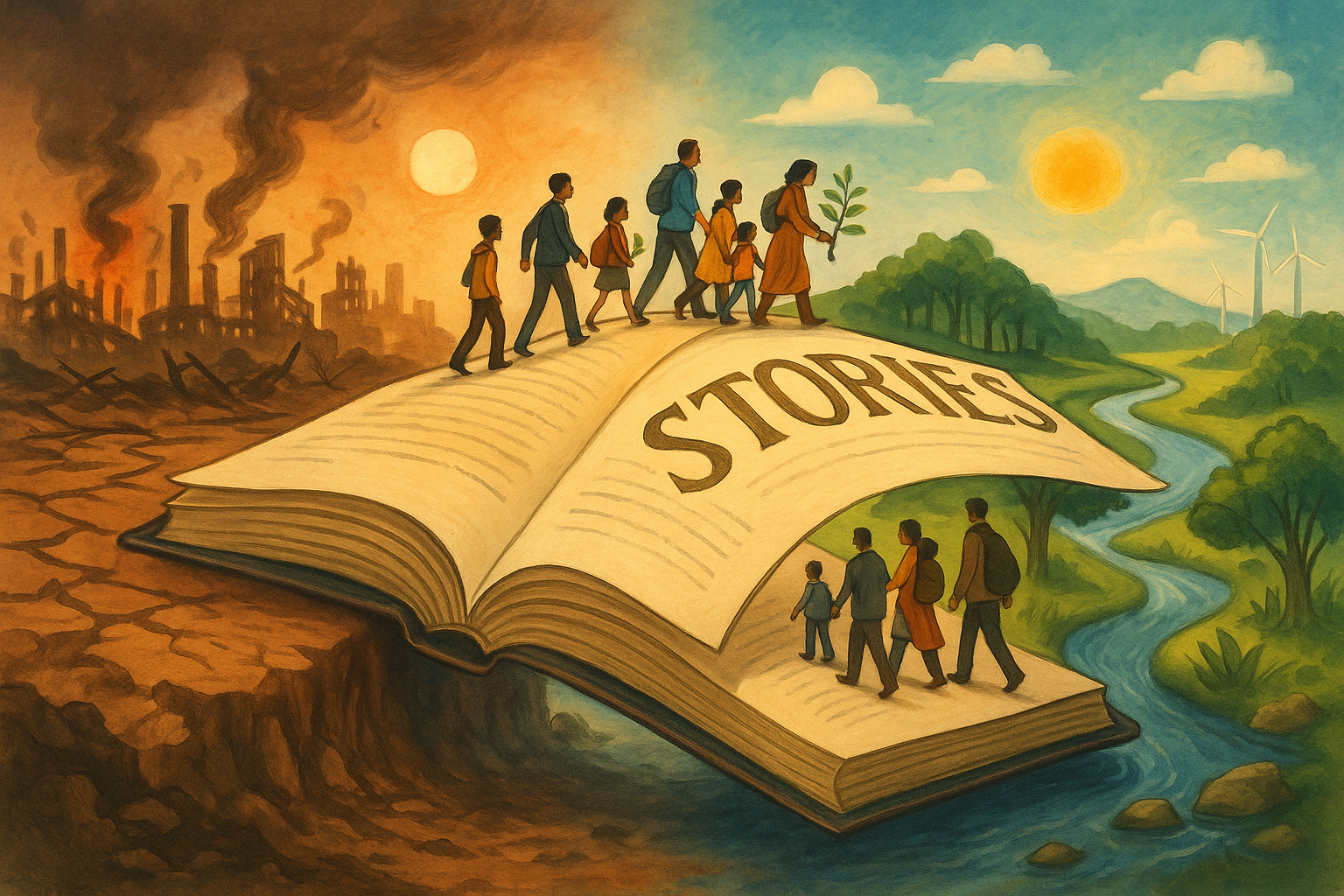
I owe my introduction to “Ecocriticism” to my daughter, now pursuing her Master’s in English Literature, whose mind works with a kind of alternate clarity. She sees narratives differently (more sharply, more intuitively), and it was through her that I realised literature can shift perspectives just as powerfully as science, but to a larger audience. If we strip academic varnish, ecocriticism is basically the humanities’ attempt to remind the world that stories do shape reality. We as sustainability professionals tend to forget this because we spend so much time convincing ourselves that rational scientific arguments, concentration pathways and AI models (last year it was spreadsheets) will save the planet. Literature can make people feel about nature, loss, responsibility, and hope. Every novel, poem, film, and comic book has the potential to shape how society perceives climate risk, maybe differently than the latest IPCC assessment report.
But as Milner points out, ecocriticism is often too Anglophone (which is a polite way of saying that it is heavily leaned on English-language writers and Western perspectives), too academic, and sometimes too detached from actual science. Yet even with these quirks, it offers something sustainability desperately needs: collective imagination. Because let’s be honest, policy guidelines rarely move people, but stories do.
Milner begins with an argument which is quite convincing; cli-fi is not a genre in its own right, at least not yet. It is an offshoot of science fiction. And he has a point. Most of the prominent cli-fi writers, Kim Stanley Robinson, Jean-Marc Ligny, Dirk Fleck, and James Bradley were science fiction writers first. Even those who resist the label, like Margaret Atwood and even Amitav Ghosh, do so more out of literary positioning than because their work doesn’t belong there. Cli-fi exists because the climate crisis exists. It’s not a neatly boxed genre; it’s a response, a literary ripple effect of scientific consensus. Cli-fi is rooted in the horror resulting from human mismanagement. What destroys worlds in these stories is not prophecy but policy failure. No angels, no demons, but just carbon.

Milner, of course, dedicates a large part of his essay to unpacking Robinson’s work, because Robinson is, frankly, the main protagonist of cli-fi’s ascent. I got to know him by reading The Ministry for the Future, and it was a book that hooked me. Robinson is one of those authors who can describe carbon drawdown, international governance, glaciology, and the inner politics of the Federal Reserve and mix it with ecoterrorism, the “Children of Kali”. The novel opens in a town in Uttar Pradesh, and that was enough proximity for me. As you read, there are occasions where you think “if only”. But as Milner points out, Robinson writes these scenarios not because they are likely, but because he believes literature should imagine what politics refuses to attempt.
This is where cli-fi becomes more than entertainment. It gives the readers a simulation of what might happen if humanity chose courage and collective intelligence, or rather, what happens if we do not. As Milner notes, one of the most unsettling aspects of The Ministry for the Future is its juxtaposition of bureaucratic climate diplomacy with violent eco-resistance movements. It lets us experience scenarios we hope to avoid without actually living them.
What the essay reveals is that cli-fi matters because it functions as a bridge between technical knowledge and our collective understanding. Sustainability professionals spend a lot of time talking about transition pathways, tipping points, and resilience metrics. But none of these phrases explain how it feels to live on a planet in crisis. Cli-fi fills that gap. It translates the scientific into the emotional. It helps people understand why climate change is not just an environmental issue but a moral, psychological, and existential one.
And perhaps that is why this essay arrives at the perfect moment. Right at the end of COP 30, all we got was grandstanding and little action. As to my training sessions on climate risk, I help professionals internalise what models and spreadsheets to use. And as the Green Literature Festival begins, it is a reminder that cultural shifts often precede political ones. Milner’s essay tells us that ecocriticism is not a luxury, nor is cli-fi a frivolous subgenre invented by publishers. They are both essential tools in reimagining the Future in a world stifled between fear and inertia; cli-fi is important.
Article 1: Higher the ESG Score, Higher the Risk of Green Washing
Article 2: Do We Really Care for Climate Change-Related Targets?

Article 3: The Hidden Cost of SDG Progress: Who’s Paying the Price?

Article 4: How susceptible are you to being Greenwashed?

Article 5: The Great Indian Political CSR

Article 6: What Does “G” Say About “E” of ESG?

Cutting through academic jargon, this monthly series distills key findings from sustainability research into actionable insights for professionals and decision-makers.


Recent Comments