Sustainability in Academia (Article 3, July 2025)
 Santhosh Jayaram
This is the 3rd in this series, Sustainability in Academia. Through this series, I select an interesting research paper that has caught my attention and attempt to explain its importance and key findings, without delving into the academic rigour. I believe it is essential to highlight the contributions of the academic fraternity to the world of sustainability.
About a month ago, when I asked a group of experienced sustainability professionals about which countries lead on Sustainable Development Goals (SDGs), they replied with some names. But the common factor that linked all their answers was that they were mostly Scandinavian countries. Not a surprise, really. You may have already read about the SDG rankings in the media. Finland, Sweden and Denmark top the rankings [1] as per the 2025 report. In India, the state of Kerala tops the ranking [2], and all these seem obvious to most of the people I spoke to.
Yet, what really surprised me was that more than 90% of the people I queried had not heard of ‘SDG Spillover’. That prompted me to cover the topic of SDG spillover for this month’s review. To help me with this analysis, I will be using two research papers as the base for this piece.
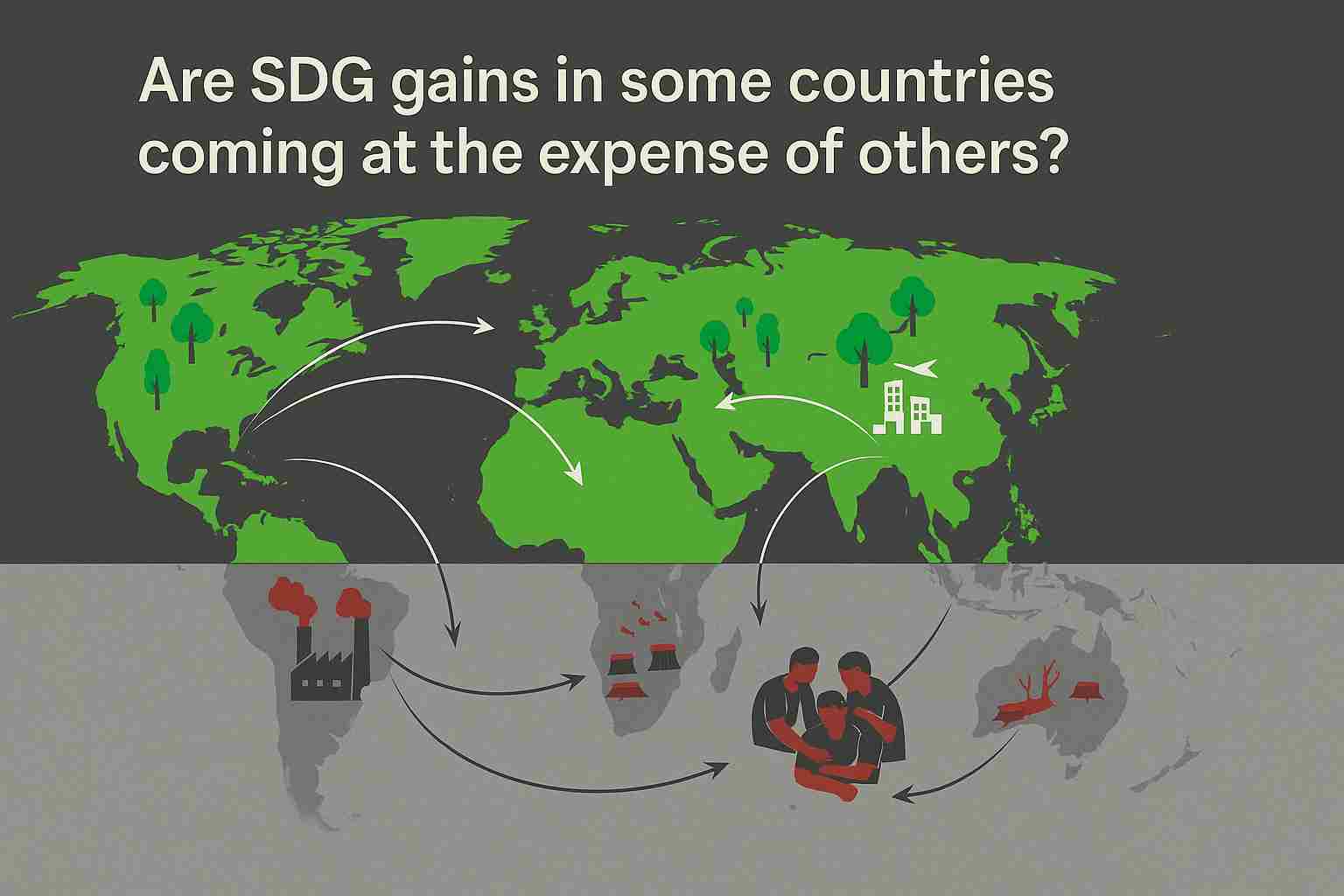
Now, before we begin — let me share a basic definition of SDG Spillover to set the ball rolling. Primarily, SDG spillover refers to the influence that a country, region, or socio-economic unit has on another, directly or indirectly, in a way that contributes to or undermines the latter’s efforts to achieve the SDGs.
To get a better picture, let us start by looking at the spillover ranking of the top 10 countries on the SDG ranking.
| Countries | Spillover Ranking |
| Finland | 139 |
| Sweden | 144 |
| Denmark | 155 |
| Germany | 146 |
| France | 147 |
| Austria | 151 |
| Norway | 156 |
| Croatia | 125 |
| United Kingdom | 149 |
| Poland | 120 |
These rankings are among 193 countries. A rank of 140 means the country is ranked 140th among 193 countries. Can you see the irony in this? To understand further, let me try to first explain what SDG Spillover is. For this, I am referring to the published article titled “SDG-nexus and spillovers at the heart of Agenda 2030“, published in January 2025.
Citation: Gómez-Paredes J, Malik A, Lafortune G (2025) SDG-nexus and spillovers at the heart of Agenda 2030. PLOS Sustain Transform 4(1): e0000157. https://doi.org/10.1371/journal.pstr.0000157
The authors clearly highlight that international attention to this spillover effect began as early as 2017. But it was recognised by the EU parliament in 2022. There is no reference to recognition anywhere else in the world. Recognising is only the first step, but ensuring international collaboration to tackle it is something which is still in its infancy, even at a time when we have only five more years to achieve the SDG Goals.
The article brings out four types of interaction that generate SDG spillover effects.
- Direct action: This can be a result of the direct intervention of Country A on Country B. It can be positive or negative. For example, it can be a war or a bilateral co-operation agreement.
- Transboundary flows: This can be related to pollution or human mobility. It can be a transboundary movement of air pollution or water pollution. It can also be migration of people or brain drain.
- Through the global commons and global public goods, this concept can be illustrated by Country A’s contribution to the international Climate Fund. Alternatively, it can be seen as Country A’s GHG emissions leading to increased losses or death in Country B.
- Through Trade: Country A influences Country B’s SDG progress by consuming what Country B produces. It can be positive externalities like employment or negative externalities like emissions, pollution or even virtual water import.

Now that you understand SDG Spillover, let me take the next published article to explain the impact of the same. This article is titled “Examining the unsustainable relationship between SDG performance, ecological footprint and international spillovers“, published in 2024.
Citation: Moinuddin, M., Olsen, S.H. Examining the unsustainable relationship between SDG performance, ecological footprint and international spillovers. Sci Rep 14, 11277 (2024). https://doi.org/10.1038/s41598-024-61530-4
This study examines three relationships between SDG progress, ecological footprint, and spillovers under the following three hypotheses.
- H1 – The richer the country, the better its SDG performance.
- H2 – The better a country’s SDG performance, the higher its ecological footprint.
- H3 – The richer the country, the worse its spillover score.
They use statistical methodologies for the study, and the results show that all three hypotheses are true. The richer countries tend to perform better on the SDGs, and their analysis showed the opposite for LDCs. This is not what we envisaged when the SDGs were set up. The authors conclude that the positive correlation towards hypothesis 1 indicates that the measurement of SDG performance remains closely aligned with conventional business-as-usual, which focuses more on economic dynamics.
The positive relationship for hypothesis 2 is explained by the authors in resonance with other studies that countries tend to prioritise socio-economic dimensions over the environment. The study also showed that some countries demonstrate the Environmental Kuznets Curve (EKC). In case you are new to this, EKC is a hypothesised relationship between environmental degradation and economic development. It suggests that as the economy grows, environmental degradation first increases, reaches a peak, and then begins to decline, forming an inverted U-shape curve. While EKC may sound logical, what we need to realise is that we are already at the brink of the planetary boundaries. On a side note, the Earth Overshoot Day for 2025 has come down to July 24 2025, namely, we are consuming resources of approximately 1.8 Earths every year.
Getting back to the SDG analysis, the positive relation demonstrated towards hypothesis 3 should be examined in conjunction with the truth of hypothesis 2. Reading together, the authors argue that higher-performing countries on the SDG ranking have not necessarily achieved absolute reduction of their environmental impacts but have ‘offshored‘ them. It also indicates that EKC is true only when the boundary setting is within the borders of a country.
These studies do bring out a very valid question. If only a few countries can achieve the SDGs by shifting the burden to others, where do we stand on the SDG agenda, which states “Leave No One Behind“? Sitting in Kerala as I write this, I am proud that Kerala has ranked number 1 as per Niti Aayog on the SDG ranking of states. The state has done many good things, but as explained in these articles, we are a consumption state. We do not produce the majority of the things that we consume, and I am sure we will be happy if Niti Aayog decides to study the spillover effect.
We are in the last leg of the SDG timeline (2030 was meant to be the end goal for SDG transformation of our planet), and it is essential to realise that SDG performance itself may not yet truly capture the environmental dimension of sustainability. As the world focuses on the next steps for the SDGs, it is critical to keep the planetary boundaries as the core.
[1] https://dashboards.sdgindex.org/
[2] https://www.niti.gov.in/reports-sdg
Academics on Sustainability
The mainstream sustainability professional appears to be a world away from the research being conducted in the academic space. This is a series of articles I will be posting as a review of some very interesting journal articles that the academic world has put out. It will focus on the key findings and my views on their implications and takeaways. I will focus less on academic rigour and more on the key messages that will be of interest to sustainability professionals and key management personnel. I plan to do this monthly.
Article 1: Higher the ESG Score, Higher the Risk of Green Washing
Article 2: Do We Really Care for Climate Change-Related Targets?

Cutting through academic jargon, this monthly series distills key findings from sustainability research into actionable insights for professionals and decision-makers.


Recent Comments