Sustainability in Academia (Article 5, September 2025)
 Santhosh Jayaram
The concept of Corporate Social Responsibility (CSR) is often traced back to Howard R. Bowen’s 1953 seminal book, “Social Responsibilities of the Businessman.”
Interestingly, Bowen’s research was supported by the Protestant Church [1], indicating that CSR, from its inception, was shaped more by non-business actors than by business voices. In India, Section 135 of the Companies Act, 2013—the world’s first legislation mandating CSR—was similarly influenced, limited by corporate thinking but significantly by politicians and bureaucrats.
It has been 12 years now since Section 135 became a reality for corporate India. Corporates spent ₹34,909 crore on Corporate Social Responsibility (CSR) initiatives in FY 2023-24 according to Fulcrum’s latest Bharat CSR Performance Report. And as they say, when the honey pot is sweet, the flies won’t be far away!
CSR as a Political Risk or Opportunity
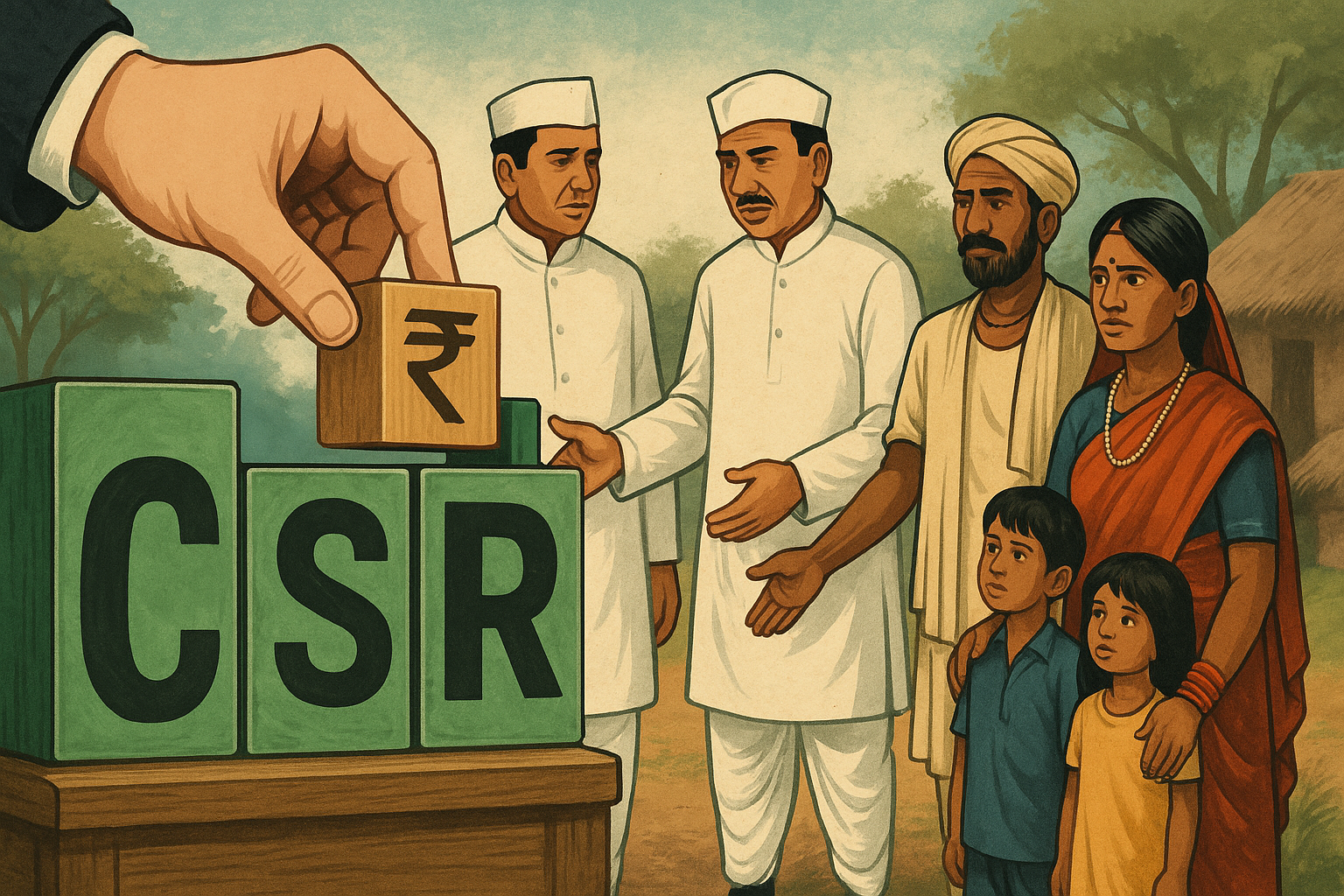
A CEO recently confided that he dreads announcing net profits in his books. The day after profits are declared, his company is inundated with “requests” (often closer to orders) from local MPs, MLAs, opposition leaders, district authorities, municipal bodies, and panchayats for funds under the guise of CSR expenditures.
In Malayalam, there is a saying:
“അത്താഴം മുടങ്ങാൻ നീർക്കോലി കടിച്ചാലും മതി”
(A bite from the harmless chequered keelback snake is enough to make you skip dinner)
For business leaders like my CEO friend, CSR has become that snakebite—non-lethal but disruptive enough to complicate operations. Today, almost every state in India has set up a CSR cell. Reports suggest that some states even mandate the Chief Minister’s approval for CSR proposals [2] or direct companies toward “priority” projects [3]. While such directions may not have legal standing under Section 135 and its rules, they still create significant pressure. Some companies comply willingly, as political proximity offers them informal leverage. For instance, supporting police station infrastructure may seem like a CSR project, as it can subtly reinforce reciprocal obligations from the state apparatus. Or consider companies spending CSR funds to aid construction of Metro stations and also getting the right to brand station with the company name [4].
The Origins
Was this ever the intent of Section 135?
An academic article by Damien Krichewsky (Business and Politics, Cambridge University Press) offers valuable insight. Based on 189 interviews conducted between 2007 and 2014, including those with MCA officials, MPs, company leaders, CSR professionals, and civil society actors, the study reconstructs how corporate social responsibility (CSR) evolved into CSR law. The quotes from the interviews listed in the article give a very good flavour of the sentiments and objectives that led to Section 135.
It traces the journey from the Voluntary Guidelines on CSR (2009), to the National Voluntary Guidelines (2011), and finally to Section 135 (2013).
I have always maintained that we should view Section 135 as part of the overall Companies Act, rather than in isolation [6]. The objective of the Companies Act was to garner better trust from investors by showcasing a stronger regulatory environment to protect their investments, and the same is the core objective of Section 135 also. The following quote from Krichewsky’s article [5] by a senior bureaucrat from MCA sets that tone.
Asked about the problems that the government was trying to address with CSR, a senior bureaucrat of the MCA stated:
“… instances where local communities have raised issues and sometimes have strongly opposed industrial projects. The now very famous case of the Nano project of Tata Motors is a good example.”
The same sentiments resonate in the quotes from a member of the Lok Sabha and a representative of a Public Sector Undertaking (PSU) in the article. This provides us with a clear basis that achieving “Social Licence to Operate” was a key objective to introduce CSR into the Companies Act.
The article takes us through the development of the Voluntary Guidelines, starting with the establishment of the Guidelines Drafting Committee (GDC) in July 2008. The author provides some pertinent points when explaining the formation of the committee. It lacked diverse representation.
“…. handpicked GDC’s members from within a small epistemic community based primarily in New Delhi………………… Trade Union leaders and activists who were more critical towards CSR were not invited.
………… the strong cohesion among the members of the GDC, which a former member described as something of a club.”
As the GDC commenced work, a sudden request from the Minister to publish the guidelines in a short period surprised the GDC members. Since the work of GDC was in progress, the Voluntary CSR guideline was published in 2009, following consultation with Industry Associations by the MCA. [7] While GDC objected to it, the parties agreed to resume the work. The conflicts between MCA and GDC continued, and it is interesting to understand the driving sentiments between these two constituencies. Finally, the National Voluntary Guidelines (NVG) were published in July 2011 [8], and as the name suggests, it was voluntary with no mandatory requirements. At this moment, the definition of CSR was still in alignment with global definitions.
“….in the NVGs, CSR is defined as a field of opportunities for companies to conduct business operations that “harmonise” their financial performance with “the expectations of society, the environment and the many stakeholders [they] interface with in a sustainable manner.” [5]
But while all this was happening, there was a parallel development happening with the Central Public Sector Enterprises, which the author refers to as the start of development towards Section 135 [5].
“In the late 2000s, CPSE knew that the government would soon require them to spend part of their profit on such kinds of CSR activities, and they asked the government to impose a similar constraint on their private competitors.
………….. As the Standing Committee on Finance (SCF), a permanent parliamentary committee, examined the bill, the idea emerged to recommend that the government include a CSR clause in the legal text. Such a clause would require companies to allocate a portion of their net profit to CSR activities. This idea was welcomed by most members of the SCF, irrespective of their party affiliation.
The author wants us to reflect on the process that led to section 135. It was not through any GDC or multi-stakeholder consultations during the drafting process, but rather through a political process. The author also explains the reason for no opposition as under [4].
“…getting more companies to spend more money on local development projects would increase resources that MPs and their local affiliates can use for patronage.”
CSR, in other words, was not born out of stakeholder consultations, but out of political consensus.
Patronage and Electoral CSR
Recent research (2025) confirms this political undertone [8]: districts receive significantly more CSR allocations during election years, particularly in constituencies where the incumbents belong to the ruling party. Funds are often channelled into highly visible projects—health, education, employment—that maximise voter appeal.
This echoes what Krichewsky foresaw in his article [4]: CSR becoming a vehicle of political patronage.
From “Comply or Explain” to “Mandatory Spend”
Originally, Section 135 was to follow a “comply or explain” model. Companies unwilling to spend would simply disclose their reasons for not doing so. However, this quickly shifted to a strict mandatory requirement, with the latest Standing Committee even recommending penal action against non-compliant firms [9].
Industry associations and the original Guidelines Drafting Committee initially resisted making CSR mandatory when the Companies Act was put up for consultation, even suggesting that CSR be collected as a tax instead. [5] But the MCA firmly rejected it, stating:
“We look for corporate social responsibility, not for government social responsibility. We do not want to make a new tax. We want you to do your projects, to give back to society, to take your responsibility.”
Over time, amendments to the rules have made CSR more compliance-heavy, but no guardrails have been added to insulate it from political influence.
Keeping Politics Out of CSR
The contrast between the NVGs (which later informed SEBI’s BRR and BRSR) and Section 135 is telling. NVGs emerged from consultations that reflected global standards and focused on building trust. Section 135, on the other hand, was politically driven, framed as a tool to manage community-company relations and ensure investor confidence.
Yet, when political patronage dominates CSR, it distorts its purpose. More so, when the Central and State Governments seek to gain patronage by expropriating CSR funds. Comparisons with the District Mineral Fund (DMF) are sobering: years later, much of the DMF remains under-utilised, and what is used is often diverted to irrelevant projects [11].
The original intent of Section 135 is better captured in the words of the then Minister of Corporate Affairs [6].
“It is not up to me to say this is CSR or not. It is up to the Board of the company. It is not a tax or a cess. We are only urging companies to spend their own money in the areas they feel most comfortable with.”
The Way Forward
Every rule has both a literal interpretation and a broader application. The spirit of Section 135 was to strengthen trust between business, communities, and investors—not to serve as a tool of political patronage.

As I argue in this fifth article of my Academia on Sustainability series, CSR must be kept free from political interference. CSR should not be a bargaining chip for politicians, nor a backdoor for companies to curry favour with governments. Establishing guardrails against such misuse must be the next step for the Ministry of Corporate Affairs.
However, the question remains: will politics permit it?
References
[1] – https://thebhc.org/index.php/abstract/90187?utm_source=chatgpt.com
[6] – https://www.linkedin.com/pulse/importance-local-section-135-companies-act-santhosh-jayaram/
[7] – https://www.nfcg.in/pdf/CSR_Voluntary_Guidelines_2009.pdf
[9] – https://papers.ssrn.com/sol3/papers.cfm?abstract_id=5279121
[11] – https://iforest.global/wp-content/uploads/2025/03/DMF-Press-Release.pdf
Article 1: Higher the ESG Score, Higher the Risk of Green Washing
Article 2: Do We Really Care for Climate Change-Related Targets?

Article 3: The Hidden Cost of SDG Progress: Who’s Paying the Price?

Article 4: How susceptible are you to being Greenwashed?

Cutting through academic jargon, this monthly series distills key findings from sustainability research into actionable insights for professionals and decision-makers.


Recent Comments