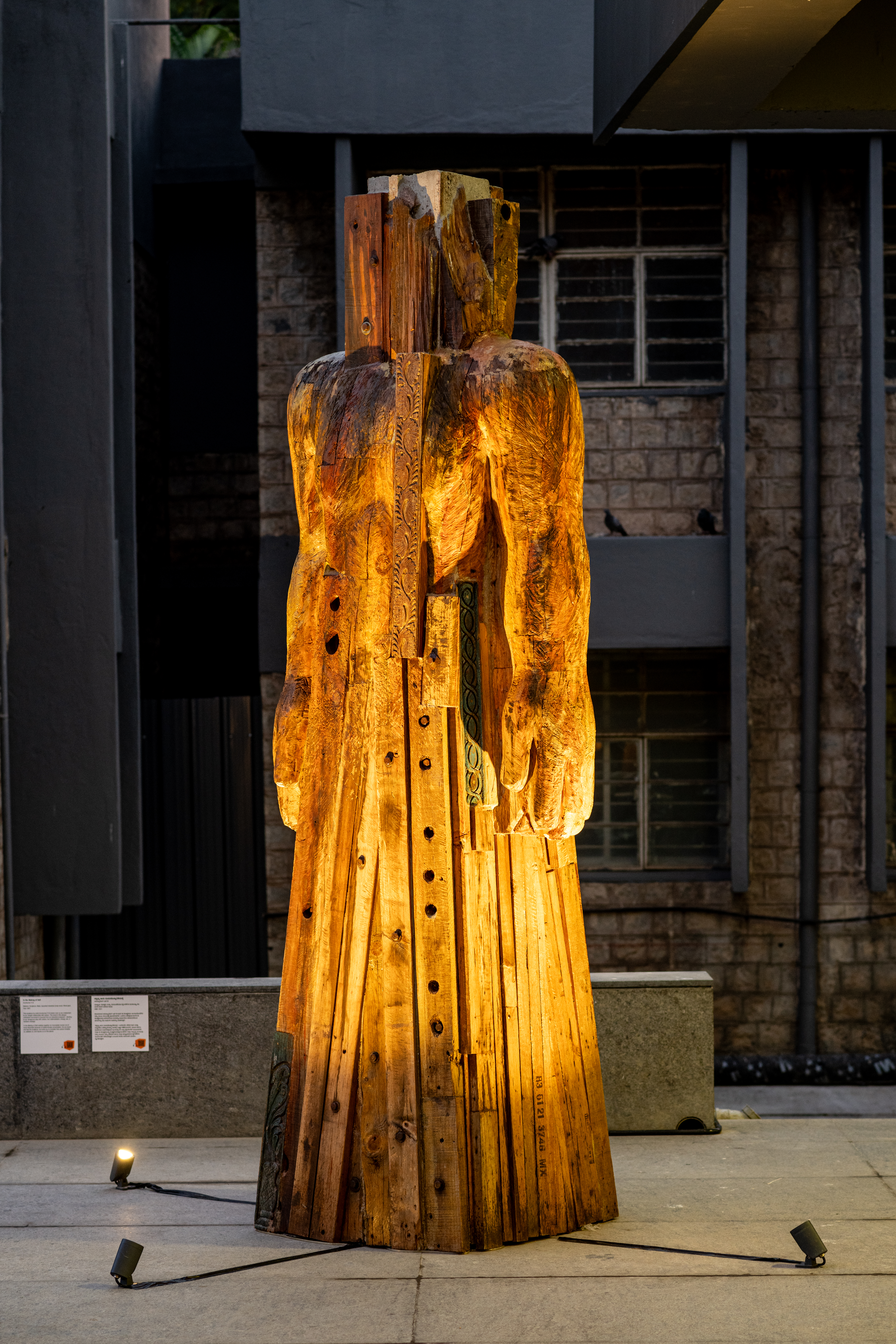
What does the ‘Balloon Girl’ mean? Both before and after the paper-shredder? Why does any random graffiti we spot (while driving through a busy street) make us pause and reflect? Why do people still look for hidden codes in a Da Vinci painting? Why is Rodin still so contagious in ‘thinking’? Why do tourists still flock around long-dated stones at Stonehenge? The answer is simple to say but difficult to grasp.
She eats paper and drinks ink. That’s how her mother would describe her when she was a child. That’s how her friends and peers would still describe her now- specially, if you ask them at gun-point. After all, she is a contemporary human who had no TV in her house – whether she was a kid or an adult all these years. That’s not only why she insists on reading and embracing art. Her cheerful, anecdote-sprinkled, simple and elegant conversation makes you wonder at the deep connection that art has to how we live and why we live.
When we met with Jahnavi Phalkey, Founding Director, Science Gallery Bengaluru, on the sidelines of Zinnov Confluence 2025, she had just finished stimulating many abstract questions and reflections in an auditorium usually abuzz with conversations on AI and IT. In this chat, this science and technology historian, author and filmmaker (Who was on secondment to the Science Museum London as an external curator (2013-2015), and is the director – producer of the documentary film Cyclotron (2020) while also being the Editor of the British Journal for the History of Science -Themes and South Asian Studies) continues painting a deliberately-incomplete, but beautifully-curious, picture about where humanity is going; and would, and how far, would art keep it company?
You unfolded the curtain on a very interesting piece of art at the Science Gallery. Where do science and art meet- or is there a Roche Limit to these two entities?
Art makes knowledge accessible. You can look at a work and have some opinion on it. Language -in Science- is getting limited now but images help make sense of a lot of things. Art creates language back in the realm of Science.
In fact, historically, up until 19th century, the language of Science was Art. If you look at Botany- can we imagine it without drawings? The separation between Art and Science came in the 20th century. Art got left out somewhere. But objectivity is in the equipment.
So that’s why you keep encouraging new works in the public domain.
Public is not some ignorant person. It knows what you know. People can relate to anthropology and Physics when they are communicated in a visual or simple medium. If you look at all the historical temples- you can see Geometry in full bloom- such precise architecture! An artist brings a critical perspective in any field. An artist also allows people to think- Do we need this?
Would you agree that smart cities have some sort of conflict when it comes to fast and easy lifestyle vs. sustainability? Between technology-related progress vs. a better planet?
I am reminded of Paris here. It’s a 15 minute city. Or some cities in Europe that are rich in pedestrian walks, ecological covers, car-free zones, a good life while having low carbon footprints. It takes planning, infrastructure investments and a good technology approach. That said, there are bigger questions to deal with. Like the energy usage issue with LLMs. These are the kind of questions that are not easily solved. We should never stop research and innovation. That’s never a good idea. But this pace and scale are not sustainable. We need to sit down and ask- do we really need all that data? What will we do with all this mindless data consumption? A lot of important questions have to be solved – and that will happen when people have information, not just more data.

Can artists and engineers come in a team? Can they walk closer towards each other- in the world we are living in?
It’s a good time for them to talk to each other. You also need more people with different lenses in policy. In UK and Germany humanists are advising on questions related to Science and Technology. It’s as easy as it can be. It can be as difficult as it can be. Disagreements will be there and that should be fine. As long as they do not affect people.
What’s your reckoning and an ideal sketch of urban spaces in India?
There is a lot of room for more free parks, more public libraries, more open spaces for picnics and community-interactions. More reading spaces.
Are books hopelessly dying?
Reading is essential. It allows a window to another world. The more that happens, the more people get comfortable with others- knowing that other worlds are not different and scary but, instead and simply, different and interesting.
Is Gen Z and Gen Alpha open for Art?
They are, contrary to what most think, open about it. We recruit most of our people through college. It’s about the experience one gets, what one gets used to- Art is not unsavoury or alien to the future generation. It’s just about the environment.
By Pratima H


Recent Comments