Sustainability in Academia (Article 4, August 2025)
 Santhosh Jayaram
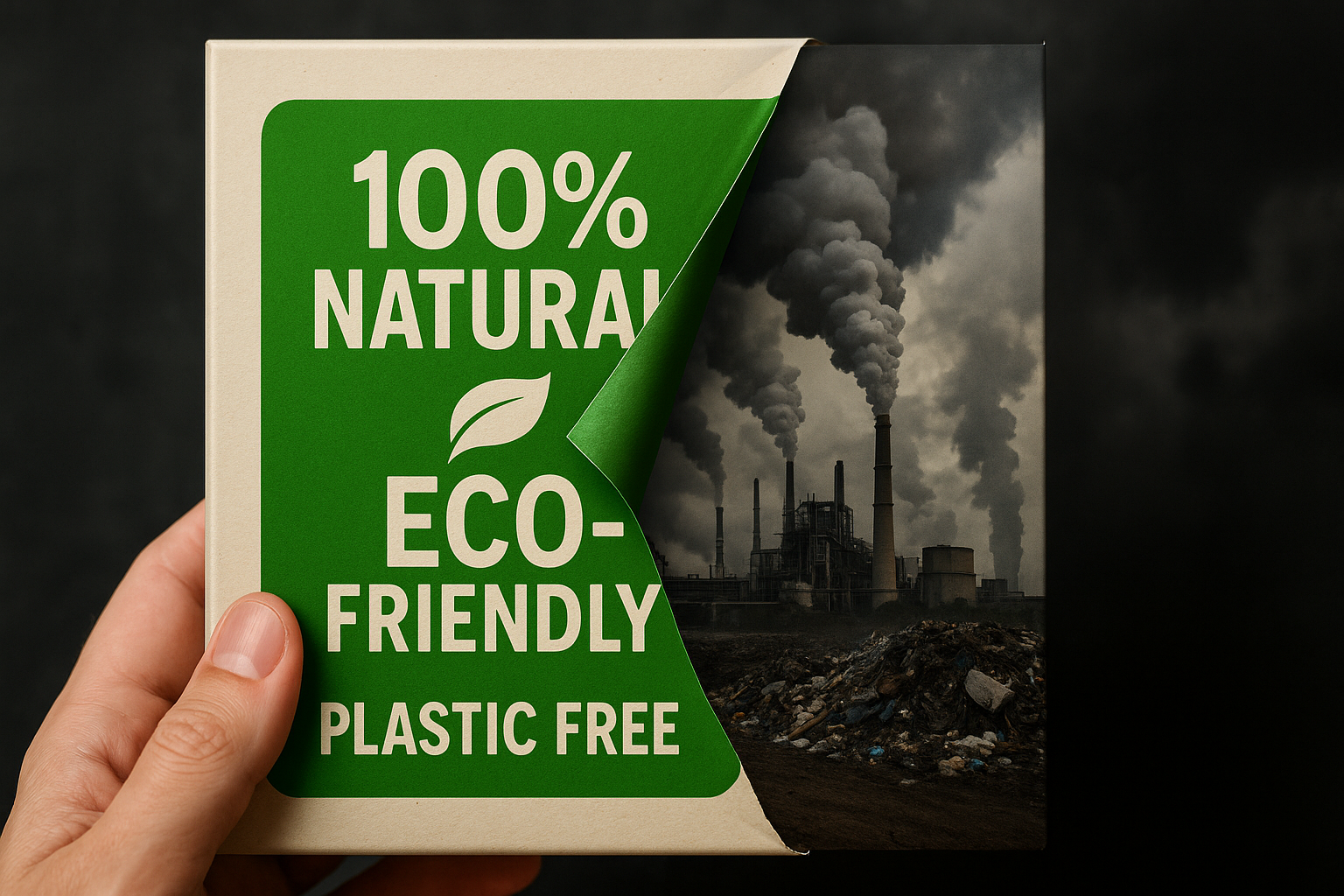
When you walk through the aisles of a supermarket, you find a whole lot of products claiming to be 100% natural, 100% recycled, eco-friendly, environment-friendly, plastic-free, and 100% biodegradable, naturally sourced, chemical free, organic, sustainable, nontoxic, energy efficient, carbon neutral, climate friendly, Ayurvedic, 100% herbal or even just claiming to be green. Add to that the images filled with green leaves, images of extraction from the natural environment or an image of a hand protecting the globe. The audacity extends to even naming the product, incorporating terms like ‘natural,’ ‘bio,’ and ‘earth,’ among others. Suppose you have picked any of these products. In that case, there is a high probability that you have fallen victim to one of the most deceitful gimmicks to delude consumers who have some level of regret about their human action on the environment.
This is the fourth in the series under Academia on Sustainability. In this series, I feature one or two research articles published in recent times that have caught my attention, which I feel convey something important that the sustainability professional community should understand. I remove the research rigour in my review and convey the study’s findings and their importance.
The first article I wanted to analyse is the one titled “Green or greenwashed? Examining consumers’ ability to identify greenwashing”.
Fella, S., & Bausa, E. (2024). Green or greenwashed? Examining consumers’ ability to identify greenwashing. Journal of Environmental Psychology, 95, 102281. https://doi.org/10.1016/j.jenvp.2024.102281
This research examines consumer perceptions of sustainable products and the extent to which they can recognise greenwashing. They conducted their study in Germany using three different products across 700 participants. The three products were toilet cleaner, hand cream and smartphone, and they classified toilet cleaner as a low-involvement product and smartphone as a high-involvement product. For each product, they created three options: honest green, greenwashed, and non-green products with distinct verbal and visual cues. I have reproduced the image from the article for better understanding.

The first finding from this study is that participants appear to be more susceptible to greenwashing in low-involvement products (like toilet cleaner) compared to high-involvement products (the mobile, for instance). The reason attributed to this is that consumers tend to invest less time in evaluating low-involvement products, and thus, pay less attention to their product cues. The purchase intentions were very similar to those of honest green products and greenwashed products. At the next level, when participants were asked to examine the green credentials and their perception of which product is more sustainable, the perceived greenness of the honest toilet cleaner was found to be better than that of the greenwashed one. However, there was not much of a difference between the hand cream and the mobile. The reason here is that environmental friendliness becomes a desirable part compared to their utility.

It was also an interesting observation that participants reported fewer greenwashing issues when they were first asked about their decision-making process and purchasing intention. It was also observed that they mentioned visual cues more often in the purchase intention than verbal clues in the packaging, which demonstrates the power of visual green(washing) cues. Overall, consumers seem to barely consider greenwashing in their initial thoughts about purchase intention (perhaps utility is the primary consideration), and while selecting, they appear to be influenced by the green look and feel, which is driven by a cognitive focus on visual cues compared to verbal ones.
These findings are significant because they reveal the tactics companies use to deceive customers into being greenwashed.
Now this was for a retail customer, I picked a study to analyse how it happens with procurement managers in companies. This is a study titled “An experimental study on the susceptibility of purchasing managers to greenwashing”.
Khan, O., Hinterhuber, A. An experimental study on the susceptibility of purchasing managers to greenwashing. Sci Rep 15, 11426 (2025). https://doi.org/10.1038/s41598-025-94482-4
The study is to examine whether a purchasing manager can reliably differentiate between greenwashed and actual certified products. They surveyed 465 purchasing managers across the EU, a region known for its regulatory emphasis on eco-certifications, which should make this study more interesting.
The study used three products: laptops, safety gloves and copy paper. The study was designed to assess differences in Willingness To Pay (WTP) by exposing one group of purchasing managers to greenwashed products and the other group to sustainable products (Certified products).
The results of the experiment with the laptops suggest that participants did not exhibit a strong preference for a certified sustainable laptop over a greenwashed one. As per the authors, “This finding implies that vague but persuasive green claims can be as influential as certifications with low perceived credibility in shaping procurement decisions”.

For the safety gloves, the participants valued certified safety gloves slightly more than greenwashed alternatives. The reason was explained as “This finding indicates that credible certifications may carry more weight for safety–critical products, though the effect was not substantial”.
In the case of copy paper, it was surprising to see a slight preference for the greenwashed copy paper over its certified counterpart. As per the authors, “This finding highlights the influence of bold but unverifiable green claims, which can sometimes outweigh even strong certifications in procurement decisions”.
In the first study, the researchers investigated the potential of greenwashing for a typical supermarket customer. However, the second paper reveals the vulnerability to greenwashing, even among experienced purchasing professionals. There is an urgent need to enhance trust in sustainability claims; otherwise, it is only a matter of time before this distrust turns into a boycott of even genuine sustainability products. There must be strong regulations in place to punish deceptive green marketing.
It is a setback that the EU’s Green Claims Directive, which aims to combat greenwashing, has been put on hold. But the EU commission clarified that it has not withdrawn the proposal, and hence, there is hope.
Regarding India, the Advertising Standards Council of India (ASCI), a self-regulatory voluntary organisation, introduced a code on environmental/green claims, which came into effect in February 2022. The Central Consumer Protection Authority (CCPA) released guidelines for the “Prevention and Regulation of Greenwashing or Misleading Environmental Claims” on October 15, 2024. They are guidelines, not a separate law; hence, they are normative and interpretive documents issued under the Consumer Protection Act, 2019 (CPA). However, they explain how existing provisions of the CPA (especially those related to “misleading advertisements” and “unfair trade practices”) will be applied to environmental claims.
Fines have been imposed in past on certain Indian companies for greenwashing:
- a mosquito repellent showing “100% natural” and “chemical-free”
- energy-efficient ACs claiming a “5-star energy rating”
- a soap where the company claimed that the product was “100% natural”, “biodegradable” and “eco-friendly”.
But these fines have been so small, and before the fine was imposed, the company would have greenwashed thousands of customers. This news also does not get the coverage it deserves. Accurate information must be readily available in an easily accessible format for customers to make informed decisions. On the other hand, we should also have robust regulations and penalties in place that prevent companies from making deceitful claims.
Academics on Sustainability
The mainstream sustainability professional appears to be a world away from the research being conducted in the academic space. This is a series of articles I will be posting as a review of some very interesting journal articles that the academic world has put out. It will focus on the key findings and my views on their implications and takeaways. I will focus less on academic rigour and more on the key messages that will be of interest to sustainability professionals and key management personnel. I plan to do this monthly.
Article 1: Higher the ESG Score, Higher the Risk of Green Washing
Article 2: Do We Really Care for Climate Change-Related Targets?

Article 3: The Hidden Cost of SDG Progress: Who’s Paying the Price?

Cutting through academic jargon, this monthly series distills key findings from sustainability research into actionable insights for professionals and decision-makers.


Recent Comments